

Accessory
Electrorheology (ER) fluids are suspensions of extremely fine non-conducting particles in an electrically insulating fluid, which show dramatic and reversible rheological changes when the electric field is applied.
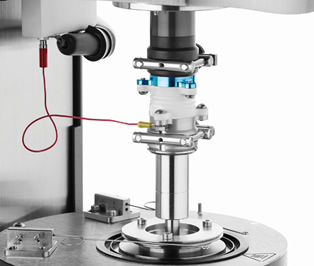
Electrorheology (ER) fluids are suspensions of extremely fine non-conducting particles in an electrically insulating fluid, which show dramatic and reversible rheological changes when the electric field is applied. The ARES-G2 ER accessory provides the ability to investigate the novel rheology of such smart materials in response to external electrical stimuli. The accessory can apply up to 4,000 volts during the course of an experiment and is compatible with both parallel plate and concentric cylinder geometries. Tests can be run with the Advanced Peltier System over the range of temperature from -10 °C to 150 °C. The test voltage is applied to the sample via a Trek Amplifier through a high voltage cable – both AC and DC voltage profiles are supported. A specially designed insulator block between the transducer hub and the upper geometry isolates the applied voltage from the ARES-G2’s electrical circuits. Additionally, a protective polycarbonate shield with interlock triggers is included with the accessory to provide safety from electrical shocks.
Features and Benefits:
- Compatible with Advanced Peltier System (APS) over a temperature range from -10 °C to 150 °C
- Choice of 25 mm and 50 mm stainless steel parallel plates and 28 mm diameter concentric cylinder geometries
- Wide voltage range: 4000 VDC, 400 VAC (8000 V peak-to-peak)
- Fully programmable from TRIOS software
- Integrated with interlock triggers for safe operation
Step Voltage on Starch Suspension under Steady Shear
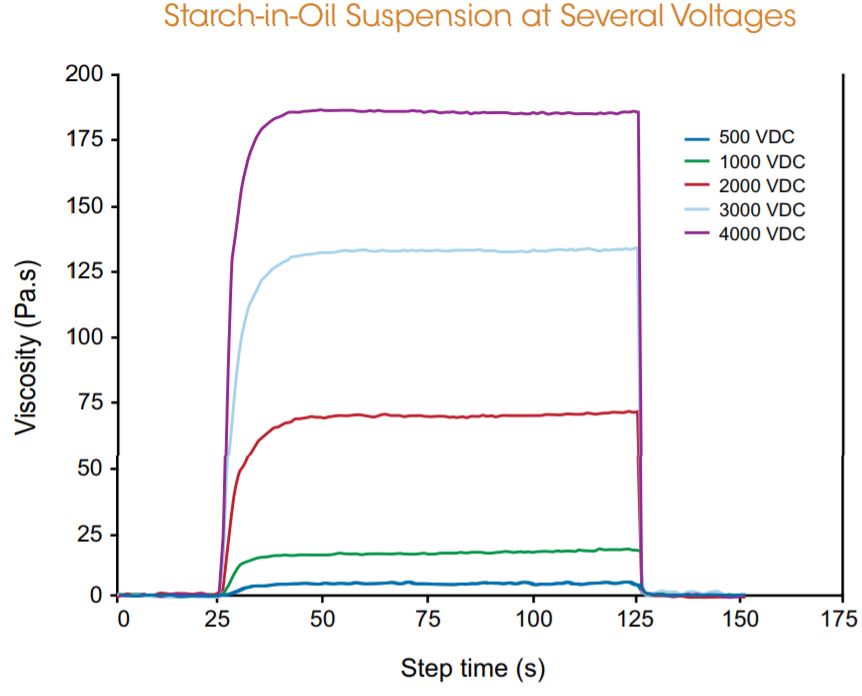
A 10% starch solution in silicone oil demonstrates dramatic and reversible changes in structure under the application of high voltage. The figure shows time-dependent viscosity with varying DC voltage, from 500 to 4000 V, applied for 100 s. The underlying rheological test is a constant rate at 1 s-1, which minimizes the disturbance to the structuring process.When an electrical field is applied, polarization of the starch particles in the non-conducting silicone oil leads to stringing of the starch particles, which align between the electrode plates. This orientation is responsible for the strong viscosity increase.
The time to align the particles depends on the viscosity of the suspending fluid and the strength of the electrical field. Because under the applied shear rate, deformation of the structuring process is not completely eliminated,a maximum viscosity is observed when the dynamic equilibrium between forming and breaking of strings of aligned particles is achieved.
- Description
-
Electrorheology (ER) fluids are suspensions of extremely fine non-conducting particles in an electrically insulating fluid, which show dramatic and reversible rheological changes when the electric field is applied. The ARES-G2 ER accessory provides the ability to investigate the novel rheology of such smart materials in response to external electrical stimuli. The accessory can apply up to 4,000 volts during the course of an experiment and is compatible with both parallel plate and concentric cylinder geometries. Tests can be run with the Advanced Peltier System over the range of temperature from -10 °C to 150 °C. The test voltage is applied to the sample via a Trek Amplifier through a high voltage cable – both AC and DC voltage profiles are supported. A specially designed insulator block between the transducer hub and the upper geometry isolates the applied voltage from the ARES-G2’s electrical circuits. Additionally, a protective polycarbonate shield with interlock triggers is included with the accessory to provide safety from electrical shocks.
- Features
-
Features and Benefits:
- Compatible with Advanced Peltier System (APS) over a temperature range from -10 °C to 150 °C
- Choice of 25 mm and 50 mm stainless steel parallel plates and 28 mm diameter concentric cylinder geometries
- Wide voltage range: 4000 VDC, 400 VAC (8000 V peak-to-peak)
- Fully programmable from TRIOS software
- Integrated with interlock triggers for safe operation
- Applications
-
Step Voltage on Starch Suspension under Steady Shear
A 10% starch solution in silicone oil demonstrates dramatic and reversible changes in structure under the application of high voltage. The figure shows time-dependent viscosity with varying DC voltage, from 500 to 4000 V, applied for 100 s. The underlying rheological test is a constant rate at 1 s-1, which minimizes the disturbance to the structuring process.When an electrical field is applied, polarization of the starch particles in the non-conducting silicone oil leads to stringing of the starch particles, which align between the electrode plates. This orientation is responsible for the strong viscosity increase.
The time to align the particles depends on the viscosity of the suspending fluid and the strength of the electrical field. Because under the applied shear rate, deformation of the structuring process is not completely eliminated,a maximum viscosity is observed when the dynamic equilibrium between forming and breaking of strings of aligned particles is achieved.


