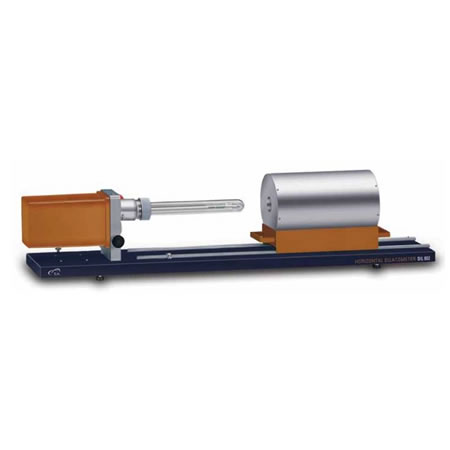
TAM IV

TAM IV is the most sensitive, stable and flexible microcalorimeter system in the world for directly measuring this universal heat signal and, therefore, the quantitative thermodynamic and kinetic observation of any process. It is a unique microcalorimeter system that is completely modular and combines the highest heat flow sensitivity with unmatched long term temperature stability for measuring many processes that are undetectable by other techniques. A wide range of calorimeter configurations and sample handling systems provide maximum application flexibility and ensure optimum laboratory productivity.

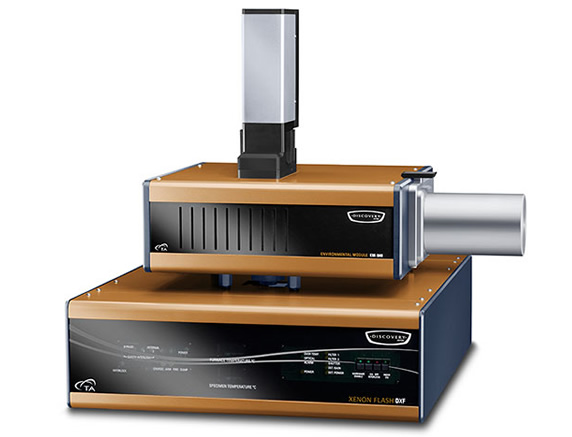
DLF 1200

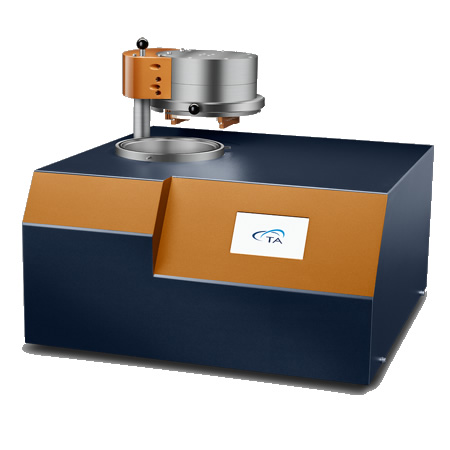
The Discovery Laser Flash DLF 1200 employs a custom Class 1 Nd:Glass Laser pulse source to provide a collimated, monochromatic energy pulse with a 300 μs to 400 μs pulse width. Ideal for labs that need to measure thermal diffusivity, heat capacity or thermal conductivity at temperatures up to 1200°C, or require the power of a laser in a compact benchtop instrument.

Equipped with a liquid nitrogen-cooled IR detector, DLF 1200 provides high precision, quick response, non-contact measurements in air, inert gas or vacuum to 10-3 torr. Simple to operate and safe to use, easy to maintain and very economical to operate, these systems are suitable for research and development programs, as well as quality control.
DXF 900

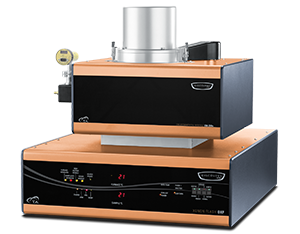
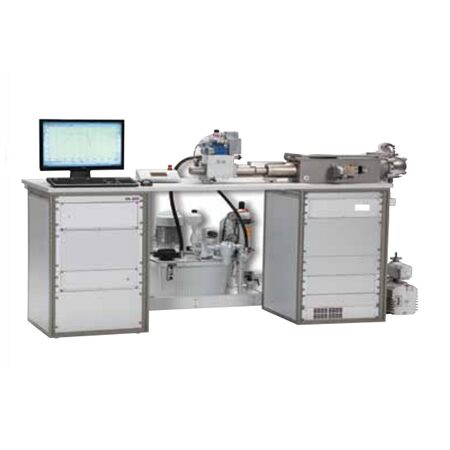
The Discovery Xenon Flash (DXF) source module employs a High Speed Xenon-pulse Delivery source (HSXD) which has considerably higher efficiency, lower costs and less maintenance than equivalent systems. A reflective optic configuration of our design effectively harnesses the power of a Xenon flash tube and, with the aid of proprietary wave guides, delivers it to the specimen inside the Environmental Module. DXF 900 produces a pulse width of 400 μs to 600 μs and uniformly concentrates the power from the flash source directly on the entire face of the specimen. Due to this optimized optical arrangement and the broad light spectrum, specimens as large as 25 mm in diameter can be illuminated with sufficient energy to make a high-accuracy measurement. The use of large samples diminishes errors associated with inhomogeneity and permits representative measurements of poorly dispersed composites.

DXF 500

The Discovery Xenon Flash (DXF) source module employs a High Speed Xenon-pulse Delivery source (HSXD) which has considerably higher efficiency, lower costs and less maintenance than equivalent systems. A reflective optic configuration of our design effectively harnesses the power of a Xenon flash tube and, with the aid of proprietary wave guides, delivers it to the specimen inside the Environmental Module. DXF 500 produces a pulse width of 400 μs to 600 μs and uniformly concentrates the power from the flash source directly on the entire face of the specimen. Due to this optimized optical arrangement and the broad light spectrum, specimens as large as 25 mm in diameter can be illuminated with sufficient energy to make a high-accuracy measurement. The use of large samples diminishes errors associated with inhomogeneity and permits representative measurements of poorly dispersed composites.

DXF 200+

The Discovery Xenon Flash DXF 200 employs a High Speed Xenon-pulse Delivery source (HSXD) with considerably lower cost and less maintenance than a laser and generates equivalent results. A reflective optic configuration of our design effectively harnesses the power of a Xenon flash tube and, with the aid of proprietary wave guides, delivers it to the specimen inside the Environmental Module. DXF 200 produces a pulse width that is shorter (400 μs to 600 μs) than many commercial laser-based systems, while uniformly concentrating sufficient power from the flash source directly on the entire face of the specimen. Due to this optimized optical arrangement and the broad light spectrum, specimens as large as 25 mm in diameter can be illuminated with sufficient energy to make a high-accuracy measurement. The use of large samples diminishes errors associated with inhomogeneity and permits representative measurements of poorly dispersed composites.

DIL 805A/D Quenching Dilatometers

The DIL805 Series comprises of four models: DIL 805L, DIL 805A are quenching dilatometers, DIL 805A/D is a quenching with the capability to deform the specimen by compression, and DIL 805A/D/T that can also stretch it in tension mode.

All four instruments are fully automated, self-contained units used to measure dimensional changes under extreme conditions of controlled heating and cooling.

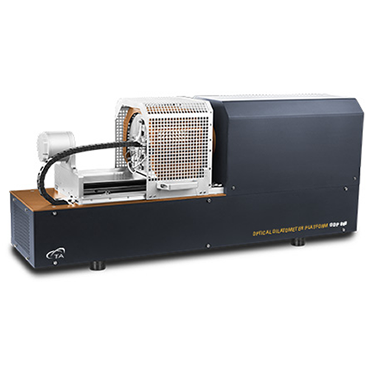
DIL 806 Optical Dilatometer

This optical dilatometric measurement method used in DIL 806 is an absolute process, entirely independent of any possible expansion or contraction of the instrument. Consequently, measured results do not need to be corrected or calibrated for different temperature programs. Coupled with the fast response of the DIL806 furnace, this makes the system particular well-suited for the analysis of dynamic processes that involve multiple temperature steps and dynamic heating rates.

DIL 820 HT HiTemp Vertical Dilatometers

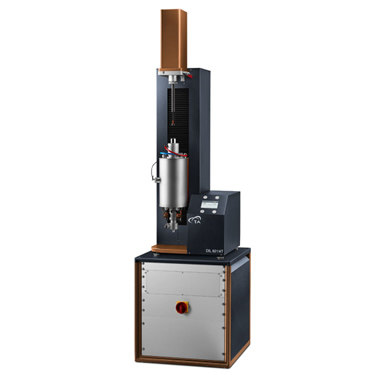
The 820HT Series operates up to high temperatures in a vertical orientation , making it uniquely set up for the analysis of sintering, studies in Rate Controlled Sintering (RCS) mode and the determination of dilatometric parameters of samples otherwise Impossible to be correctly analyzed on classic dilatometers with horizontal design.

Available in two different models (DIL 821HT and DIL 822HT), both the units feature the new optical encoder with 1nm resolution. That when combined with the True Differential of the DIL822HT, the result is simply the best possible sensitivity and CTE accuracy in the high temperatures segment.

DIL 820 Series Vertical Dilatometers

The 820 Series operate in a vertical orientation, making it uniquely set up for the analysis of sintering, studies in Rate Controlled Sintering (RCS) mode and the determination of dilatometric parameters of samples otherwise difficult to be analyzed on classic dilatometers with horizontal design.

Available in two different models (DIL 821 and DIL 822), both the units feature the new optical encoder with 1nm resolution. That when combined with the True Differential of the DIL822, the result is simply the best possible sensitivity and CTE accuracy on the market.

DIL 802 True Differential Dilatometer

For highest measurement accuracy, DIL 802 and DIL 802L provides a truly differential measurement. Measuring only the difference between the sample and the reference specimen, the True Differential design negates the influence of measurement system expansion on the sample measurement. This measurement design is of particular benefit for dynamic temperature programs such as those employed in Rate-Controlled-Sintering (RCS) and for measurements at lower temperatures. The DIL 802 is designed for measurements under vacuum or inert gas while the DIL 802L is designed for measurements under air.

DIL 801 Single Sample Dilatometer

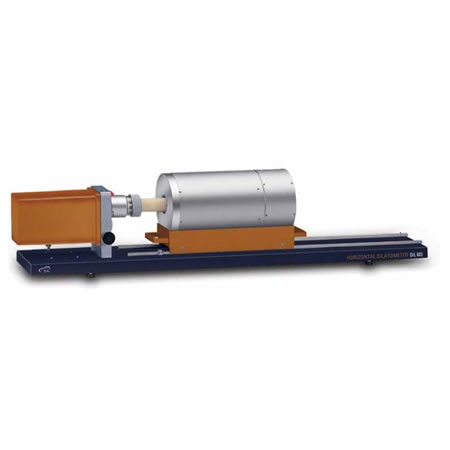
Suitable for a wide range of routine dilatometric tests, the DIL 801 and DIL 801L are horizontally configured single-sample dilatometers. The DIL 801 is designed for measurements under vacuum or inert gas while the DIL 801L is designed for measurements in air, making the DIL 801L ideally suited to measuring ceramic materials which are often processed in air.

Without a doubt DIL 801 and DIL 801L represent today the dilatometers with the best price / performance ratio on the market

FOX 600 GHP

FOX 600 GHP is especially well-suited for thermal conductivity measurements at high temperatures, exhibiting unrivaled temperature and dimensional stability. Each of its components include state-of-art technology representing the best available today in advanced materials and electronics.

In a Guarded Hot Plate system a temperature difference (ΔT) is established across a sample of known thickness (L). The thermal conductivity is calculated from the temperature difference across the known thickness and the steady state power (W) per area (A) required to maintain the temperature difference. The Guarded Hot Plate uses a direct measurement of the electrical power supplied to the hot plate rather than heat flow meter signals from a Heat Flux Transducer.