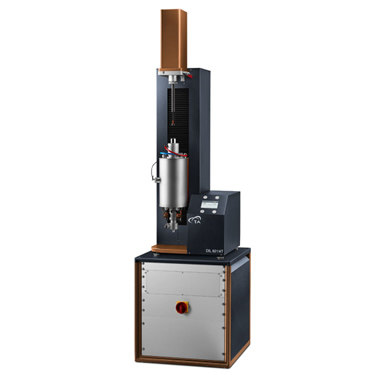
Determining the Mechanical Properties of Non-Woven PLGA Scaffolds
To Characterize the Variation in Material Properties of Non-Woven PLGA Fibers
DetailsTo Characterize the Variation in Material Properties of Non-Woven PLGA Fibers
DetailsThe interaction between the antigen binding site and an antigen is extremely specific, which has made antibodies very highly desirable reagents when developing a wide variety of antigen detection assays.
DetailsSummary Although mechanical recycling is the dominant technology today, it is not enough to meet the plastic industry’s growing sustainability needs. Mechanical recycling requires high-quality, clean, and sorted recycled waste, which is only a small fraction of all recycled plastic. The products of mechanical recycling often have degraded properties compared to virgin polymers. In contrast,…
DetailsOverview In this Tech Tip, we introduce the new DHR Polymer Melt TRIOS Guided Method.
DetailsOverview In this Tech Tip, we introduce the new DHR Polymer Torsional TRIOS Guided Method.
DetailsDielectric Measurement Extends material characterization capabilities by providing an additional technique similar to dynamic mechanical. Description Technology Features Applications Dielectric Measurement The Dielectric Accessory extends material characterization capabilities by providing an additional technique similar to dynamic mechanical. In dielectric analysis, an oscillation electrical field (AC Field) is used as opposed to mechanical force (stress) and…
Details<< View all ARES Rheometer Accessories Dielectric Thermal Analysis Accessory (DETA) Uncover deeper insights by measuring the impact of a mechanical deformation on the conductive network, all powered by one simple accessory Dielectric thermal analysis unlocks insights into the microstructure of complex fluids. ARES rheometers are capable of simultaneous electro-rheology or stand-alone dielectric measurements. Leveraging…
Details